The Perils of "Do You Understand?" & How to Check Comprehension Effectively

August 12, 2025

Share this post
If there is one thing you should never do as a language teacher (or in life), it is to ask "Do you understand?"
No one wants to admit in front of their peers that they don't understand! Humans live in fear of being the only person in a group who hasn't understood something. It makes the palms sweat, the heart beat faster, and the face turn a telltale shade of red.
Faced with this question, most people will nod, agree, and hope that the next activity will bring clarity—or at least be simpler.
In this blog post, I will share much more effective ways to check that students have understood.
1. Concept check questions
Concept check questions zoom in on detailed aspects of the language. They allow teachers to check that students have understood a grammar point or the meaning of a vocabulary item. They are particularly helpful after presenting a new grammar target.
Asking the right concept check questions can take some practice. When you're starting out in teaching, you might want to prepare them before a lesson. Over time, you'll likely be able to create your own as and when the need arises.
Here are some top tips for concept check questions:
- Keep it simple. Questions with short answers are the best. Aim to use very simple wh- questions, or questions with yes/no or either/or answers.
- Use language students already know. Try not to use more complex concepts or vocabulary than the one you are checking. So don't ask questions in past perfect progressive when you're checking understanding of the simple past.
- Play around with different questions. It's okay to ask a few questions to check meaning.
- Ask questions to focus on the meaning and form.
Let's use the following sentence to teach the simple past: "She went to the ice cream shop last night." Some concept check questions might be:
- Where did she go? > The ice cream shop.
- Is she at the ice cream shop now? > No.
- When did she go? > Last night/yesterday.
- Is "last night" about the past, present, or future? > Past.
- Is "went" present or past tense? > Past.
- To talk about "now," do I use "went" or "go"? > Go.
You can find more about concept check questions in this British Council blog post: Checking Understanding
2. Physical concept checks
To check understanding and get students our of their chairs, you could bring an element of movement into the classroom. Designate each corner of the classroom as "yes," "no," or "maybe." Have students stand up, ask them a concept check question, and ask them to move to the corner of the room that answers that question. You could also do this by having students stand in a line and step left for "yes," step right for "no," and stay in the same place for "maybe."
3. Mediation
Mediation is another way to check understanding. While concept checking relies on the teacher asking the right questions to assess students have understood, mediation allows students to take a more active role in demonstrating it.
Mediation tasks prompt students to take notes, summarize, critically evaluate, compare information, and rephrase content. They allow learners to share their understanding with others by putting their learning into practice and perhaps explaining it to others.
You can find out more in this blog post: Mediation: The What, Why & How Explained
4. Visual checks
Visuals are a great way to check understanding. You could have students create their own visual summaries, sketchnotes, mind maps, infographics, timelines, or doodles to check meaning. For example, ask them to draw (or point to) a tomato or the verb "run." You could also show them a couple of visuals and ask them which is correct or to adapt it to be correct.
You could also use visual metaphors to allow students to share how confident they feel about a topic. Leave colored circles with "traffic lights" on their desk and have them display "red" if they definitely need support, "orange" if they might need help, and "green" if they are happy with their understanding. This also works well with weather symbols (a rain cloud = I need help / a sun = I'm all good) and emojis (sad face = help me / happy face = I don't need help).
5. Peer-to-peer learning
The best way to learn is to teach something! I've always found that students love to "be the teacher." It is an instant confidence boost to be trusted to explain something to someone else and a great way to give students a chance to share their understanding with others. It also has the added bonus of allowing students to potentially explain concepts in their first language so they can express and understand it more easily.
You could pair a student who feels confident with a student who needs more support, and have them explore the linguistic point in more detail. Alternatively, have students check each others work or write quizzes or comprehension questions for each other.
6. Assessment tools
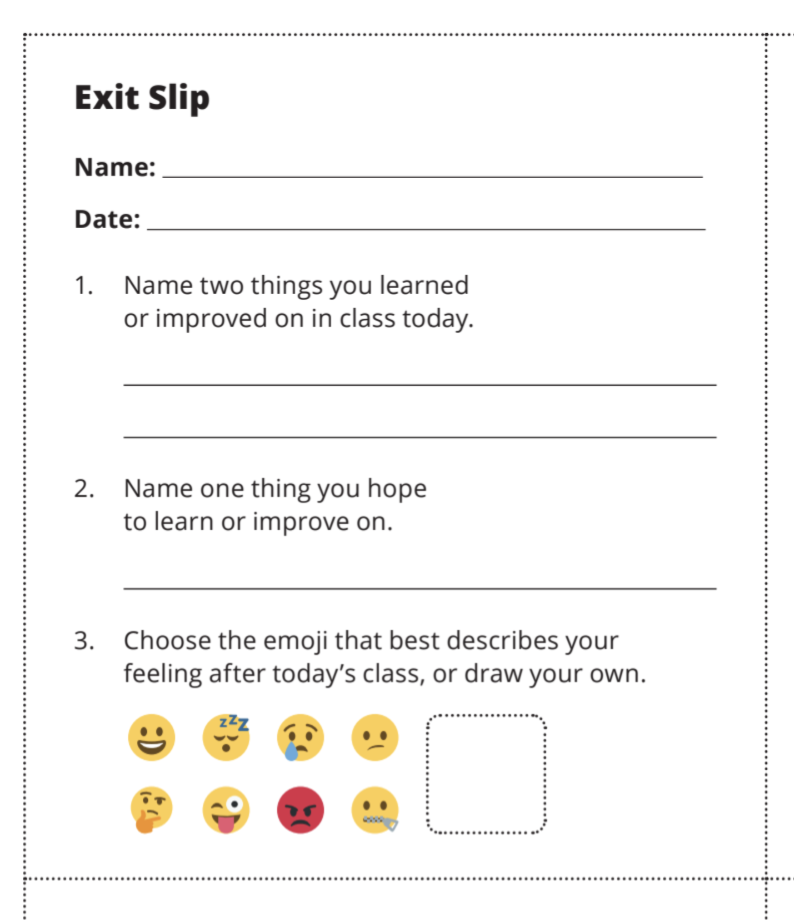
Ellii has over 70 assessment tools designed specifically to help teachers check students' understanding. These range from placement tests to needs assessments and reflection tools.
Here is an example from the Exit Slips resource. Students can complete these before leaving to help them evaluate and share what they learned in class that day.
You can access these resources here:
Here are some other blog posts on checking reading comprehension that we think you'll love:
- Pre-Reading Activities to Boost Comprehension
- 10 Activities to Increase Understanding While Reading
- 9 Post-Reading Activities to Help Students Get the Most Out of a Text
Have you tried any of these techniques to check understanding? What are your top tips? We'd love to hear your experiences and ideas. Let us know in the comments!
Comments


There are no comments on this post. Start the conversation!